
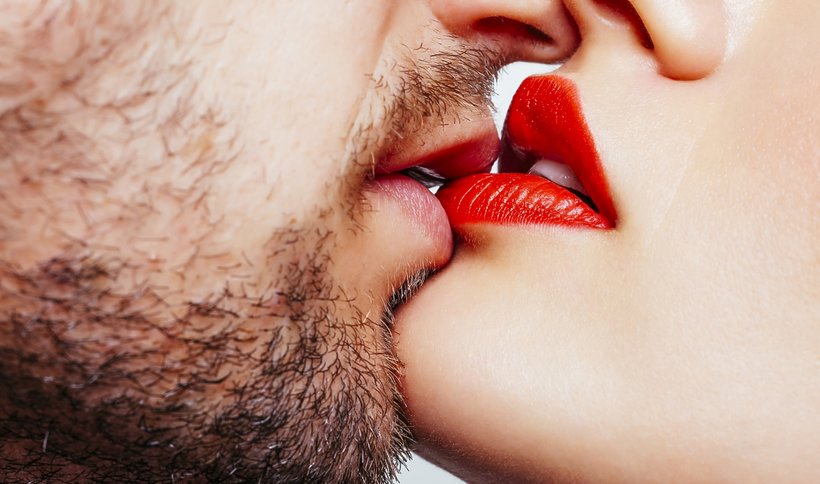
Do you like kissing? You'll likely answer "Yes" and be very surprised by this question: who doesn't enjoy hugs, kisses, and other affectionate acts with a loved one?
Have you ever wondered why nature and evolution created humans as "kissers"? After all, sweet and romantic kisses are actually more complex than you might imagine. And they can even be dangerous (at least not harmless after scientific explanations). Is kissing so romantic from a scientific perspective, and why did humans start kissing in the first place? Why do people kiss - a description of kissing from a scientific perspective. The following information may not appeal to passionate romantics, people who are convinced of the saying, "All that is natural is not ugly," or even to those who like to get straight to the point without any preludes.
From a biological perspective, too many substances and microorganisms are involved in such intimate contact; the mere thought of it spoils the romantic mood. More precisely, 9 ml of water, 0.7 mg of protein, 0.18 mg of organic substances, 0.71 mg of fat, 0.45 mg of salt, and 10 million to 1 billion bacteria—this, in addition to emotional sympathy and physical attraction, is what connects you with another person during a so-called French kiss.
But the most unpleasant part: scientists from the University of Arizona have proven that even serious sexually transmitted diseases (for example, syphilis) can be detected with a simple "wet" kiss. So next time you want to cling to a strange guy in a nightclub, you'd better remember this information. But this is all from a biological perspective; the science of sociology views kisses in a much more interesting way—as evolutionary mechanisms that (no less) helped humanity survive and create society. If we compare humans with primates (for example, body contact is highly developed in chimpanzee groups), both we and their kisses are not only part of the marriage ritual but also an element of intimacy, affection, emotions, social bonds, and the bonding of members of a society. And if participants are united, the survival of a group or society is obviously much easier. However, even scientists who have devoted their entire lives to studying human behavior still cannot isolate a single factor that became fundamental to the emergence of kissing in human society. To date, two elements are considered fundamental: psychological sympathy and the inveterate instinct to perpetuate the race.
Studies have shown that kissing helps humans choose ideal partners and steer clear of unsuitable ones. From a scientific perspective, this is simply explained: saliva contains not only bacteria and substances that react chemically but also hormones that "suggest" a partner's suitability on a physiological level. And it's true: you've probably had experiences where someone seemed very attractive and exciting before the first kiss. If the kiss was unpleasant, rejection set in. By the way, scientists have proven that women are more selective about kissing. Listen to your feelings when kissing and don't try to build a relationship with someone who is obviously unpleasant on a physical level—you can't avoid disappointment in the future. And remember: whatever scientists say, for us ordinary people, a kiss will always remain a manifestation of romance.
Data: 2025-08-14 10:31:14

OL-AN ANDRZEJ BECZEK
ul. Żytnia 13, lok. 142
01-014, Warszawa
NIP: 9511083753
REGON: 141181245
Opening hours
Mon-Fri: 10:00-18:00
Advice and reception:
+48 603 330 054
info@olan-estetyka.pl





 Strefa kobiet
 Strefa mężczyzn